
Green Economy Roadmap: The Stories
 The past couple of years have been trying, but our country is on the road to recovery. We still have a long way to go, but America is beginning to turn crisis into opportunity — economically, environmentally and socially.
Every day, we hear stories of people from every part of the country sowing the seeds of green prosperity. Some of these stories stem from the unprecedented green investments in President Obama's Recovery Act. Some are the stories of everyday people doing their part to improve their communities. All of the stories are inspiring examples of how green jobs offer real opportunity for prosperity and advancement.
Our "Green Economy Roadmap" plots out dozens of these stories from across America. Below, you can read these stories in text form.
Jump to a state:
AK • AS • AZ • AR • CA • CO • DC • FL • GA • ID • IL • KS • LA • MD • MA • MI • MN • MO • MT • NE • NV • NJ • NY • OR • PA • SD • TN • TX • UT • VT • WA • WI • WV • WY
ALASKA
Alaska's Cook Inlet Tribal Council receives more than $67,000 for green job preparation
Anchorage, Alaska
Alaska's Cook Inlet Tribal Council will receive more than $67,000 in job training money. The funding will help support the growth of green jobs and the expansion of training programs for the local indigenous community.
Websites: Click here and here to learn more.
AMERICAN SAMOA
American Samoa Performs Weatherization for Working People
American Samoa will use its Recovery Act funds to weatherize approximately 225 homes over the next three years. Homes occupied by the elderly, the disabled or families with children will be given priority. The territory will also give preference to households with a high energy burden or large energy use. Weatherization activities will include the installation of cost-effective compact fluorescent lights, solar water heaters, refrigerators, window air conditioners, and low-flow faucets and showerheads. After demonstrating successful implementation of its plan, the territory will receive nearly $360,000 in additional funding, for a total of almost $720,000. American Samoa's Territorial Energy Office (TEO) will oversee the program and perform weatherization services directly, reducing administrative costs.
Recovery Act Funding Stream: Weatherization Assistance Program ($287,804)
Website: Click here to learn more.
ARIZONA
SolFocus Cuts Ribbon on Expanded Glassworks Factory in Mesa
Mesa, Arizona

SolFocus is a leading developer of Concentrator Photovoltaic (CPV), a type of solar energy technology. Using the 30% manufacturing investment tax credit set aside by the Recovery Act, SolFocus was able to expand its manufacturing floor space by 175% and start a new line of advanced manufacturing equipment. The SolFocus Glassworks facility will be able to employ more 150 fulltime employees a year (a 200% increase from 2008) and increase the plant’s production capacity by over 15 times its 2008 capacity.
Website: Click here to learn more.
Navajo Nation leads Indian country with new green jobs legislation
Window Rock, Arizona
The Navajo Nation Council made history during its 21st Summer Session (July 20-24, 2009) by passing groundbreaking green jobs legislation. The Council voted 62-1 to establish a Navajo Green Economy Commission. This five-person body will seek funding for and oversee the approval of small-scale green projects such as wool mills, farmers markets and home weatherization. The Council also voted to create a Navajo Green Economy Fund, which creates an account for receiving federal, state, local, and private funds to make these green projects possible.
Website: Click here to learn more.
ARKANSAS
Arkansas Will Improve More Than 5,000 Low-Income Homes in the Next Three Years
In just three months, Recovery Act investments have improved more than 100 low-income homes in Arkansans, raising living standards while lowering energy costs for the residents. With an annual budget of roughly $3.5 million, Arkansas's weatherization program is usually able to provide energy-efficiency retrofits to 1,000 homes a year. With $48 million from the Recovery Act's Weatherization Assistance Program investments, Arkansas will be able to improve an additional 5,578 homes over the next three years.
Recovery Act Funding Stream: Weatherization Assistance Program ($48 million)
Website: Click here to learn more.
CALIFORNIA
Creating Jobs Through Native Gardens

Image: UCLA Today
The City of Los Angeles and UCLA are getting behind the green movement to transform thirsty lawns into native gardens by entering into a new partnership to help train gardeners in drought-tolerant practices. The green gardener training course helps create jobs, protects the environment, and provides a good workforce development model.
Thirty-one gardeners participated in the pilot training program in 2010, and close to 100 additional participants enrolled in the second round of classes, which was funded with $250,000 in federal stimulus money, through the city's Community Development Department, and conducted in partnership with the Institute of Popular Education of Southern California, an immigrant education group.
Gardeners are selected by coordinators at day laborer sites throughout Los Angeles, and are trained over six days. The training educates gardeners in sustainable strategies for making better use of water, such as incorporating drought-tolerant plants, drip irrigation with more advanced controllers, and mulch. The curriculum, developed by the Los Angeles and San Gabriel Rivers Watershed Council, also focuses on soil types, sun patterns, microclimates and how to work with clients to educate them in water-saving gardening practices.
The UCLA Downtown Labor Center is creating a job placement co-op, Native Green LLC, for newly certified green gardeners to help place them with the right homeowners who can use their skills at installing and caring for drought-tolerant landscaping. The worker-owned co-op will help expand the program by providing leadership development, marketing and outreach to neighborhood councils and homeowner associations to find potential customers, and provide a customer service model. In addition, it will help many day laborers transition from poverty wages to supporting themselves and their families, all while the city benefits with more sustainable gardens using less water.
San Francisco's Environment Now Program Helps Build Green Careers
 In September of 2009, the San Francisco Department of the Environment, utilizing ARRA Temporary Assistance for Needy Families (TANF) emergency funding, developed a project-based green jobs training program, called Environment Now. Environment Now is a sub-set of the city-wide subsidized employment program called “Jobs Now!”
Environment Now's focus is to support soft skills development, workforce readiness and technical job skills alongside eco-literacy and environmental stewardship. Participants in the program draw on these skills to conduct environmental outreach activities throughout San Francisco, with a heavy emphasis on neighborhoods in need. Because a significant number of Environment Now participants come from these underserved communities, they are able to reach audiences that the Department of the Environment has traditionally had difficulty reaching, thus increasing community participation in the City’s environmental initiatives. Projects in these neighborhoods range from energy efficiency and recycling, to toxics reduction and food security.
Sample Projects
Energy Watch
SF Energy Watch is a program that helps businesses save money on their energy bill by offering free energy assessments and installation of energy-saving equipment at a reduced cost. Environment Now team members visit targeted businesses, letting them know how the program works, pointing out energy-saving opportunities they see upon entering the business, and encouraging businesses to sign up for a free assessment. To date, Environment Now's outreach efforts have resulted in nearly 500 San Francisco businesses getting free energy assessments.
Zero Waste
 San Francisco has set an ambitious goal for Zero Waste by 2020, which requires residents and businesses of the city to properly sort their recyclable and compostable material. In support of this goal, Environment Now has launched targeted outreach campaigns to educate the residents of the city. Environment Now Zero Waste outreach efforts include phone banking to residents, door-to-door canvassing, commercial sector service needs assessments, and zero waste coordination for special events. These outreach efforts have initially focused on harder to reach communities and underserved populations. By reaching new audiences using an effective face-to-face method, the city has seen a historic increase in composting rates in traditionally low-performing neighborhoods.
Environment Now’s Future
As of August 31, 2010, the ARRA TANF Emergency Fund has not been extended, which means that many employees in the Jobs Now program will soon be out of work. However, due to the success of the Environment Now program, the Department of the Environment has been able to internally fund 18 participants to remain in the program, where they will continue to build their skills in green careers.
For more information about the San Francisco Department of the Environment, please visit www.sfenvironment.org. To learn more about the TANF Emergency Fund, please visit www.clasp.org/issues/pages?type=temporary_assistance&id=0001
Construction Careers at Metro: Moving LA Forward
 On Wednesday, May 26th, Los Angeles Alliance For A New Economy (LAANE), and its allies celebrated another victory for working families: the Board of Directors of the Expo Line Construction Authority (A Governing Board of the LA County Metropolitan Transit Authority) unanimously approved the negotiation of a Project Labor Agreement and Local Hire requirements for the final phase of construction on the Exposition Line. The policy will cover $1.63 billion dollars worth of work, generating over 6,500 good middle-class jobs while building critical mass transit for Los Angeles.
The Exposition Light Rail Transit Line (Expo Line) will travel along the Exposition railroad right-of-way between downtown Los Angeles and Culver City. Nine new stations will be constructed along the route, which will cover approximately 8.6 miles and will parallel the heavily congested I-10 freeway.
This is a victory for residents across Los Angeles County: the local hire requirements of the policy mean that construction careers will be a reality for thousands of people in communities suffering from poverty, unemployment and foreclosure. Putting people back to work in career-track jobs will change lives; building mass transit will change our city, making LA a more environmentally friendly place to live.
LAANE worked with a coalition that included the Building Trades, the LA County Federation of Labor, and community allies to pass this policy. All of the organizations are proud to bring construction careers to Los Angeles County, and feel that the Expo Line is the right track to move LA forward.
For more information on the Exposition Line, visit www.buildexp.org
For more information on LAANE, visit www.laane.org
Sacramento Mayor Kevin Johnson Launches Greenwise Initiative
With the launch of Greenwise Sacramento in May 2010, Mayor Kevin Johnson made a public commitment to putting Sacramento on the map as the greenest city in the greenest state in the nation. He wants California's capital to be a center of green innovation. The centerpiece of Mayor Johnson's second year in office, Greenwise Sacramento lays the foundation for moving the Sacramento region towards a clean-energy future that improves the health, wealth, and well-being of its residents, including its most vulnerable communities.
Over the next eight months, the Greenwise Sacramento Taskforce — comprised of leaders from the business, non-profit, labor, academic, and government sectors — will coordinate, align, and leverage efforts regionally around a common vision. The Taskforce will also set sustainability goals focused on the environment, economy, and education. Mayor Johnson has urged stakeholders to "come together collectively" around a bold, shared vision that fosters a thriving regional economy, creates high-quality green jobs and career ladders, develops policies and practices that support existing green businesses and attract new ventures, and increases the public's "green IQ," or awareness about what it means to be green.
Recovery Act Funding Streams: Leveraging multiple investments (including energy-efficiency and green jobs training funding) totaling $220 million.
Clean Truck program in Los Angeles creates good green jobs
Rafael and Blanca
Rafael is a truck driver at the Port of Los Angeles. He often works 15-17 hours each day to make the payment on the new clean truck he drives, because his trucking company refuses to pay for it. Watch his video message for Congress above.
Diesel trucking, which is concentrated around America's major port cities, is one of the dirtiest jobs in America. And it harms public health too; Eighty-seven million Americans live and work near ports that violate Federal air quality standards. Asthma, cancer, and other diseases cause by pollution have astronomical rates in these regions.
But a campaign to clean up America's ports is making these jobs clean and safe for workers and surrounding communities. The EPA Award-winning Los Angeles Clean Truck Program has put more than 6,000 clean diesel and alternative energy trucks on the road and reduced diesel emissions by 80 percent since it was first enacted in 2008. The key to the success of this program is a requirement that trucking companies, not individual low-income truck drivers, pay for the purchase, operation and maintenance of new, clean trucks.
This success is having national impact, thanks in part to organizations like the Partnership for Working Families (http://www.communitybenefits.org/), Los Angeles Alliance for a Clean Economy (http://www.laane.org/), and the East Bay Alliance for a Sustainable Economy (http://www.workingeastbay.org/), which are bringing together environmental and labor partners to promote clean and safe ports in cities like Los Angeles, Oakland, Seattle, New York and Newark.
Learn more about the Coalition for Clean & Safe Ports: http://www.cleanandsafeports.org/
Green Worker: Evelin Palacios
 Before co-founding a new eco-housecleaning co-op, Evelin Palacios worked with toxic products. Her boss did not allow gloves, saying she could work better with bare hands. She worked 10 hours a day for $50. Heading home from her old job, Evelin struggled with cracking skin on her hands as well as daily headaches and dizziness.
These days she returns from work happy, almost as if she hasn’t been to work at all. And best of all, she says, she no longer smells like bleach. Joining the WAGES co-op, Evelin became a business owner, earning three times what she made before. Evelin says she’s not the only one who’s happy. Her sense of financial security extends to her mother in El Salvador. Evelin’s small monthly payments are now bigger checks that arrive twice a month. But the happiest of all may be her five-year-old daughter, who finally got the special boots she had been admiring.
California Green Job Corps Uses Recovery Act Funds to Train Young Workers for Green Jobs
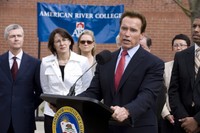 Governor Schwarzenegger launches the California Green Corps. Photo from the governor's website.
With a $10 million investment from the U.S. Department of Labor and another $10 million leveraged from its own public-private partnerships, California is funding 11 regional California Green Job Corps pilot programs across the state (including one from the Los Angeles Community College District). These pilot programs will provide 1,500 at-risk youth with career training in energy efficiency, green building, green waste, agriculture and natural resources, solar power, and alternative automotive fuel. Participants will also learn through service opportunities and on-the-job training with Habitat for Humanity.
Recovery Act Funding Stream: U.S. Department of Labor ($10 million)
Website: Click here and here to learn more.
Federal Recovery Act Dollars Create Hundreds of Bay Area Jobs
Bay Area, California
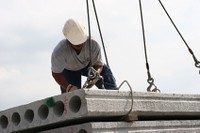
The California Department of Toxic Substances Control and the U.S. Environmental Protection Agency announced $5 million in grants and low-interest loans that will help bring nearly 500 jobs to the Bay Area and turn contaminated property into land for apartments, retail shops, day care centers and a park. Funds for the revitalization work come from the $1.8 million in federal stimulus money, along with money from the Department's Revolving Loan Fund Program, which offers low-interest loans and grants to clean up contaminated sites known as brownfields.
Recovery Act Funding Stream: Environmental Protection Agency ($1.8 million), plus revolving loan funds
Website: Click here to learn more.
Rising Sun Energy Center Grows Green Jobs in Energy Efficiency
Berkeley, California
Rising Sun is a green workforce development non-profit which provides low-to-no-cost efficiency services to Bay Area households, with a focus on under-resourced households: moderate- and low-income residents, renters, and non-English speakers.
Its California Youth Energy Services program employs youth in green jobs - summer positions in which they serve the community with free energy and water-saving Green House Calls.
Its Green Energy Training Services program prepares adults with barriers to employment for entry level jobs in the energy efficiency industry - and continues to place its graduates into healthy, well-paying positions at whole home performance and building retrofitting companies in the Bay Area.
Rising Sun also helps run the East Bay Green Job Corps, a collaborative project with other Bay Area organizations. It provides young people with barriers a green 'bridge' towards a meaningful next step, via training, wraparound services, and a chance to perform free CYES Green House Calls as a service for their community.
Website: Click here to learn more.
Berkeley Leads with City-Wide Voluntary Sustainable Energy Financing District
Berkeley, California
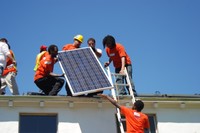
Berkeley FIRST is a solar financing program in the City of Berkeley. It provides property owners an opportunity to borrow money from the City’s Sustainable Energy Financing District to install solar photovoltaic electric systems and allows the cost to be repaid over 20 years through an annual special tax on their property tax bill. Only Berkeley property owners who voluntarily participate in the Berkeley FIRST program pay the tax.
Website: Click here to learn more.
L.A. Construction Careers and Green Jobs Policy Provides New Pathways to Prosperity
Los Angeles, California
Los Angeles's new Construction Careers Policy will ensure good green jobs for thousands of construction workers and provide middle-class career opportunities to at-risk populations. This is the first program to tie a Project Labor Agreement and local-hire requirements to privately developed projects that receive funding from local government. Its first-in-the-nation status highlights Los Angeles, and the organizations that sponsored the policy, as leaders in the effort to strengthen America’s middle class.
Website: Click here to learn more.
Oakland Starts New Revolving Loan Fund to Retrofit Homes, Create Jobs, and Funnel Benefits into Community
Oakland, California
With nearly $2 million from the Recovery Act's Community Development Block Grant funding, Oakland is seeding a new revolving loan fund to help low- and moderate-income residents weatherize and retrofit their homes. Residents will get interest-free deferred loans to hire licensed and insured contractors who are committed to hiring local Oakland workers (like those in the groundbreaking Oakland Green Jobs Corps training program). Community benefits include weatherization retrofits and energy cost savings for low- and moderate-income homeowners, neighborhood blight reduction, reduction of carbon footprints, and the creation of approximately 108 entry-level jobs.
Recovery Act Funding Stream: Community Development Block Grants ($2 million)
Website: Click here to learn more.
Solar Richmond
Richmond, California
Solar Richmond provides green-collar job training and placement in solar technology. Solar Richmond works closely with diverse partners in city government, the non-profit world and local businesses, in order to foster a green economy in Richmond and bring good, green jobs to its residents.
Website: Click here to learn more.
San Francisco Helps Businesses Upgrade to More Energy-Efficient Ways
San Francisco, California
San Francisco Energy Watch offers businesses and multifamily property owners new energy-efficient equipment and professional services at greatly reduced cost. Participants can save energy and money while at the same time reducing their impact on the environment. The benefits of the program include free on-site assessment to identify energy savings, expert installation of energy-saving equipment, and lower utility bills over the life of the new equipment. The program is a partnership between the City and Pacific Gas and Electric Company (PG&E) and is being implemented by the Department of the Environment.
Website: Click here to learn more.
Bay Area Women Growing Green Businesses, Creating Healthy Jobs
Oakland, California
Over the past decade, WAGES (Women's Action to Gain Economic Security) has built three successful green housecleaning cooperatives that have given hundreds of women the opportunity to become financially secure, gain business skills, and lead healthier, fuller lives. WAGES is currently launching an ambitious effort to significantly expand its co-op network throughout the San Francisco Bay Area to involve 200 or more worker‑owners by 2010. By using a cooperative business model, WAGES helps women pool their skills and work together to succeed. The workers make decisions democratically, and they distribute business profits equitably to all workers. As co-owners of successful businesses, women increase their incomes substantially and help their families move out of poverty.
Website: Click here to learn more.
COLORADO
Recovery Act Fuels Mile High Youth Corps Expansion
Denver, Colorado
Denver-based Mile High Youth Corps (MHYC) places nearly 200 youth each year into green service jobs in land and water conservation, energy-efficiency, and construction. Now, Recovery Act funds are allowing MHYC and five other Youth Corps programs in Colorado to expand. Together, these six programs will engage an additional 238 youth in projects that conserve energy and protect public lands, while preparing them to succeed in the workplace.
Recovery Act Funding Streams: Corporation for National and Community Service ($832,831); U.S. Department of Labor Green Jobs Capacity Building Award ($99,855)
Website: Click here to learn more.
On the Front Line in the Fight Against Dirty Energy: Veterans Green Jobs
Boulder, Colorado
Based in Boulder, Colorado, Veterans Green Jobs trains veterans in home weatherization and efficiency. The organization launched its first class of 15 trainees in April of 2009, for a nine week Green Jobs Training Program. Trainees learned how to audit a building to identify where energy is being wasted, caulk leaky holes, install energy efficient appliances, and insulate attics. They also learned and worked alongside other veterans, a best practice for supporting veterans’ successful transitions back into civilian life.
Websites: Click here and here to learn more.
Union Station Redevelopment Project creating good, green jobs
Denver, Colorado
In downtown Denver, a mixed-use redevelopment of land around historic Union Station will create good, green jobs and community benefits. Union Station will be the hub of FasTracks, the expanded metro light rail system. As a result of three years of organizing by the Campaign for Responsible Development (CRD) and FRESC, private developers on the project have agreed to "LEED" green building standards, living wages and prevailing wages for service workers, and targeted apprenticeship utilization goals for construction jobs on the site. The CRD is still working to secure affordable rental housing on the site.
Website: Click here to learn more.
Washington, D.C.
Weatherize D.C. - Providing a Model of Sustainability in the Nation's Capital
Washington, D.C.
 Weatherize D.C. is a program of The D.C. Project, a nonprofit whose mission is to advance economic and environmental justice by creating clean energy careers for people who need them the most. The program works with community leaders from across the city to provide economic opportunities to D.C. businesses and residents from communities of poverty and high unemployment. A six-month organizing campaign in a handful of D.C. neighborhoods in September 2009 launched an extraordinary interest in home weatherization, and led to 20 D.C. homeowners investing approximately $80,000-$100,000 in energy efficiency-focused upgrades. With the help of community organizers and business leaders, Weatherize D.C. is working to build a citywide movement to ensure that clean energy jobs go to the people in D.C. who need them most.
To learn more about Weatherize D.C. and the D.C. Project, visit http://www.weatherizeDC.org/
FLORIDA
Orlando Utilities Commission Pilots Solar Program
Orlando, Florida
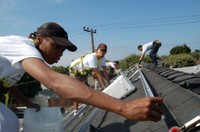 Workers install solar panels.
The Orlando Utilities Commission Pilot Solar Program enables homeowners to obtain loans for solar installation and earn credit from their solar energy production. Through the Pilot Solar Program, the Orlando Federal Credit Union provides 0% to 5.5% interest loans for residential and commercial solar systems. The loans can be repaid gradually over time as fixed payments on customers’ utility bills. Any excess electricity generated back to OUC’s electric grid is credited to the homeowner at the full retail rate.
Website: Click here to learn more.
GEORGIA
Let's Raise a Million
Atlanta, Georgia
Let’s Raise a Million, founded by students at Morehouse college, seeks to bring energy-efficiency and education to low-income neighborhoods in Atlanta. The project, now run by students in 8 Atlanta colleges, connects the dots in the communities at greatest risk to climate change impacts. Let’s Raise a Million installs energy-saving compact florescent light bulbs in homes, while educating residents about how they can reduce energy use and save money.
Website: Click here to learn more.
Georgia Partners with AmeriCorps to Create Green-Collar Program
In Georgia, AmeriCorps is using Recovery Act Funds to finance the Georgia Recovery Corps, a one-year special initiative that focuses, in part, on providing Georgians with green construction experience and training. The Georgia Recovery Corps is teaming up with Cobb Housing Incorporated (CHI) to rehabilitate homes, address erosion control, and teach skills in green careers. Participants get training in green building techniques and full-time construction jobs for skilled workers while rehabilitating foreclosed properties. So far, CHI has created 20 jobs for Georgia Recovery Corps members.
Recovery Act Funding Stream: Corporation for National and Community Service grant ($476,950)
Website: Click here to learn more.
IDAHO
Framing Our Community, Inc. - Reducing Rural Poverty Through Integrated Economic Development
Elk City, Idaho
 Framing Our Community, Inc. (FOC) has partnered with State and Federal Land Management Agencies to save our national forest and the communities within. Tucked away in the Clearwater Mountains of North Central Idaho, Elk City, Idaho lies within the boundaries of 2.2 million acres of the Nez Perce National Forest. Its population is 500.
FOC has created an integrated economic development program to address the economic decline and environmental deterioration that the community and surrounding forest have faced for many years. Their "Jobs in the Woods" program creates educational opportunities and full-time jobs in the fields of Hazardous Fuels Reduction and Forest/Watershed Restoration.
The organization's economic development programs include the Elk City Business Incubator, "Artists In the Woods" E-Commerce Program, and their Small Business Start Up Training, which graduated its inaugural class in November of 2010. The intensive 12-session Business Start Up Training takes emerging entrepreneurs through a comprehensive training that includes business plan development, sales pitch training and a final "shark session" where the participants have an opportunity to present their business plans in front of funders. At the time of graduation, half of the businesses were operational and several had been funded, including a business that produces hand tied fishing lures, which are being sold in multiple stores throughout the region and a custom wood beam and dimensional lumber producer who has sold to a niche market in Mexico.
FOC believes that being good stewards of the forest strengthens ties to the land, improves the natural resources that their community depends on, and ultimately provides food, clothing, shelter and the social fiber that is necessary for Elk City and its surrounding communities to thrive. Future plans include a Biomass Power Cogeneration facility, expansion of the Small Business Incubator and a Traditional Skills/Natural Disaster Response Team School.
For more information on Framing Our Community, Inc., please visit www.framingourcommunity.org
ILLINOIS
Chicago Creates Green Deconstruction Work Program for the Formerly Incarcerated
Chicago, Illinois
 Using $4.6 million in Recovery Act funds, Chicago is partnering with Breaking Ground and the Safer Foundation on a two-year program that provides 140 formerly incarcerated persons with job training and temporary jobs in a new building deconstruction work program. This program avoids the waste of traditional demolition by removing materials in city-owned buildings in an environmentally sound way that salvages the materials for re-use in the building industry.
Breaking Ground has trained many workers who now work daily to remove nails and salvage lumber from dilapidated buildings. The Safer Foundation provides competency-based training in 23 discrete skills, including warehousing, retail, logistics, soft stripping, recycling and carpentry. After going through this training, clients work on removing materials from city-owned buildings and garages that have been identified for removal. The city sells up to 80% of the removed materials, reinvesting the proceeds in the program. The initial funding from the City's stimulus money provided 70 clients with 24 hours of weekly training and work experience for one year, as well as an additional 10 hours a week of non-paid "soft skills" training, mentoring and support groups.
Read more about how Chicago has used Federal Economic Stimulus Funds to create more than 650 “green jobs” for the formerly incarcerated.
Growing Home
Chicago, Illinois
Growing Home provides job training for homeless and low-income individuals in Chicago through a social enterprise business based on organic agriculture. The program provides experiential learning opportunities and employment in the horticulture field as well as a unique job readiness curriculum that helps reintroduce participants back into the workforce.
Website: Click here to learn more.
Greencorps Chicago Prepares Ex-Offenders for the Green Economy
Chicago, Illinois
Greencorps Chicago bridges the most economically disadvantaged people with the Chiacago area's nascent green economy. Greencorps Chicago provides paid nine-month training programs in five lines of work: landscaping, weatherization, environmental remediation, electronics recycling, and household hazardous materials processing. Over its fifteen-plus years, Greencorps Chicago has succeeded especially in involving people leaving the prison system and others with strong barriers to employment. By providing a stable source of income in its four days-a-week training program, and a creditable background in high-demand skills, Greencorps has helped roughly 80% of its graduates move on to steady employment in the industry of their training. Every year, about 40 people graduate the program, with about 20 people working part time as staff and instructors.
Recovery Act Funding Stream: U.S. Department of Labor Green Jobs Capacity Building Award ($100,000)
Website: Click here to learn more.
Small Green Business profile: Carol's Express in Chicago
Chicago, Illinois
Carol's Express, LLC, makers of ceXpress Products, is a family owned and operated WMBE dedicated to providing the black consumer with high quality nature-based hair and skin care products at an exceptional value. With an humble brand that traces its roots back to a kitchen table and a dream, ceXpress products is no stranger to modest living, understanding the need to have a product that's going to fit into your budget while satisfying your need for quality. Carol’s Express is a proud Walmart supplier and other fine retailers, committed to making the urban community we serve more green. Carol's Express works with Green For All's Capital Access Program Coaching Platform.
KANSAS
Greensburg, Kansas: The Greenest City in America?
 Three years ago, Greensburg, KS, was victim to the worst tornado to ever blow through the region. The twister was a force of nature and destroyed nearly everything. Eleven people died. Ninety-five percent of the buildings were toppled, and nearly all of the town’s 1400 resident were left homeless.
Still fresh with grief from losing everything, Greensburg city officials knew they had to rebuild. They knew they wanted better and smarter infrastructure and quickly made the decision to rebuild green. Greensburg lies in the middle of one of the reddest states in the Union, and many of the residents were uncomfortable with environmentalism. Well before any of the green initiatives broke ground, many of the town’s long-time residents moved on. Others, uncertain of the outcome, felt that going green was exciting and gave them something to look forward to.
Now with a population of about 800, the city has bloomed: the entire town is lit by LED streetlights; the energy efficient City Hall was made from reclaimed brick and wood; the city’s glass-enclosed Arts Center was built to LEED platinum standards, and is powered by a trio of small wind turbines and eight rooftop solar panels. Tests on over 100 new homes built since the disaster show energy efficiency has improved by an average of 40 percent over homes built to conventional building codes. Some residents have seen their winter bills reduced by as much as two-thirds. The John Deere dealership in town boasts a cut in energy by nearly 40%, largely due to the reuse of oil at the dealership.
The Greensburg Wind Farm, which began commercial operation in May, will create significant economic and environmental benefits for the City. A joint venture between John Deere Renewables, NativeEnergy Inc., USDA Rural Development, Kansas Power Pool, and the City of Greensburg, the wind farm will generate enough energy to power 4,000 homes – more than enough for every home, business, and municipal facility in Greensburg. John Deere Renewables is the owner and operator of the wind farm, but the City will retain the rights to the green benefits from about 1/3 of the wind farm, making the town “wind powered.” NativeEnergy will purchase the remaining REC output, converting the RECs to carbon offsets for its customers. The energy generated by the wind farm will displace fossil-based energy and reduce hundreds of thousands of tons of carbon pollution that otherwise would enter our atmosphere.
For more information on the Greensburg Wind Farm, visit www.nativeenergy.com
For more information on green initiatives in Greensburg, visit www.greensburgks.org
LOUISIANA
28-acre Urban Farm Project: Sprouting Hope in New Orleans
The BP oil spill in the Gulf of Mexico has been an environmental and economic disaster for communities throughout the region. With a heavy base in the fishing industry, the local Vietnamese community has been one of the hardest hit. Local leaders are working to create quality, long-term green jobs to offset the economic costs of the oil spill.
The Mary Queen of Viet Nam Community Development Corporation supports New Orleans East, a large Vietnamese and African-American community. It provides business development, affordable housing, urban farm, community organizing, social services, healthcare outreach, and environmental justice programs. Now, it is hoping its plans for a 28-acre Viet Village Urban Farm can help lead New Orleans to a sustainable future. This farm will create green jobs and provide healthy food to the community. The organization is hoping to break ground in 2011.
"The urban farm project...encompasses basically every single topic you can imagine," says James Bui, "from environmental justice to job creation to real estate development to organizing. A lot of the Vietnamese seniors here have been growing microgreens, herbs, and fresh vegetables right in the backyards of their homes. Now they can be self-employed and accrue extra income."
"We wanted to provide a way to have the job training to go into different kinds of green career pathways," adds John Nguyen of the Vietnamese American Young Leaders Association of New Orleans. "[The urban farm] is going to be a way [for the farmers] to sell their crops, to sell their produce for that season."
Green For All looking forward to seeing how this exciting project unfolds, and to supporting it in whatever way possible.
Louisiana 'Leads By Example' with State-Wide Retrofits on University Buildings
Louisiana is using some of its State Energy Program funds for a “Lead By Example” program that will fund energy-efficiency retrofits of state university buildings. This will reduce energy consumption, allow state schools to focus more money on teaching, and create green-collar jobs for Louisiana workers.
Recovery Act Funding Stream: State Energy Program ($71 million)
Website: Click here to learn more.
New Orleans Pursues Comprehensive Plan for Energy Efficiency and Sustainability
New Orleans, Louisiana
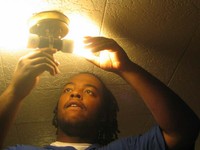 The City of New Orleans is working to pool Recovery Act funds to coordinate and establish energy efficiency retrofit programs. The city’s programs will be based on successful models like Clean Energy Works Portland, the Cambridge Energy Alliance, and Green Jobs - Green Homes New York. Using best practices from these models and mirroring a successful Louisiana Green Job Corps program, the city will work to maximize the demand for services and job growth, and expand pathways out of poverty.
Recovery Act Funding Stream: Energy Efficiency and Conservation Block Grant ($600,000). Potentially another $50.7 million from the Weatherization Assistance Program.
Louisiana Green Corps Prepares Youth for Future Green Jobs
Metairie, Louisiana
The LA Green Corps educates youth ages 17-24 in green construction, weatherizing homes, material deconstruction and reuse, and energy-saving techniques. After gaining valuable knowledge about energy efficiency, Corps members put their learning to work in local residents’ homes, making renovations that save residents money on their energy bills and lower global warming pollution. The community learns about saving energy and going green from Corps members, who learn valuable job skills.
Websites: Click here and here to learn more.
MARYLAND
Civic Works Creates Green Jobs in Weatherization and Brownfield Remediation
Baltimore, Maryland

The Baltimore-based urban service corps, Civic Works, is creating green jobs through weatherization, green construction, landscaping and brownfield remediation. Their "3E team" provides free residential energy retrofits in low-income homes as well as a fee for service program for higher income homeowners, making homes more affordable and more comfortable in addition to reducing the home's carbon footprint. Thanks to Recovery Act funding, in 2010 Civic Works will weatherize 100 low-income homes for Baltimore's Weatherization Assistance Program. Civic Works also received funds through the Maryland Energy Administration to weatherize 35 transitional homes for adults with disabilities, as well as funding to weatherize an additional 25 low-income homes. Their B'more Green brownfields job training project recruits unemployed and underemployed residents and prepares them for environmental careers in remediation and abatement. They typically run two classes of twenty participants each year and have maintained an 89% job placement rate. B'more Green graduates typically secure employment earning an entry level wage of $12 to $16 per hour.
Recovery Act Funding Streams: Weatherization Assistance Program, Community Development Block Grants and YouthBuild
Website: Click here to learn more.
MASSACHUSETTS
Boston Goes Green for High Quality Green-Collars Jobs
Boston, Massachusetts
Boston is using $6.5 million in Recovery Act funds to reduce the city’s greenhouse gas emissions by 40,000 metric tons annually while creating 100 high-quality green-collar jobs. These Energy Efficiency and Conservation Block Grant funds will jumpstart Renew Boston, a public-private partnership aimed at increasing energy-efficiency and alternative-energy services for Boston residents and businesses. As part of the Renew Boston Residential Energy Efficiency Pilot Program, project partner Next Step Living, Inc. will provide more than 150 Boston homes with free professional energy efficiency audits and retrofits.
Recovery Act Funding Stream: Energy Efficiency and Conservation Block Grant Program ($6.5 million)
Website: Click here to learn more.
JFYNetWorks trains green-collar workers
Boston, Massachusetts
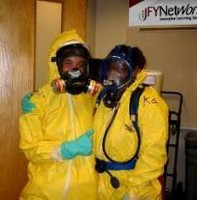 JFYNetWorks trains green-collar workers.
In 2008, the cities of Boston and Cambridge adopted programs to make buildings energy-efficient. JFYNetWorks responded immediately by meeting with energy service companies to determine what green positions needed to be filled. With the support of a $200,000 state Pathways out of Poverty grant, JFY created a new solar installation and assembly training program. The organization will also launch an energy-efficiency training program for conducting energy audits and performing building weatherization. JFY’s green job training now spans a wide range of green jobs: environmental clean-up, energy conservation, and conversion to renewables.
Website: Click here to learn more.
Massachusetts's $1.4 billion Energy Efficiency Plan
Boston, Massachusetts
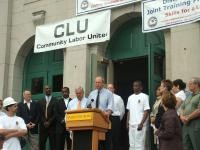
On October 27, 2009 Massachusetts adopted a plan that will use $1.4 billion in ratepayer fees and other funds to cut greenhouse gas emissions, create high-quality jobs in the state’s highest-unemployment communities, and provide up-front financing so low-to-moderate income residents can save money and do deep energy-efficiency retrofits on their homes. This is a breakthrough for the Green Justice Coalition, an Apollo Alliance Affiliate made up of community-labor-environmental-faith partners who worked with the state on the plan.
Website: Click here to learn more.
MICHIGAN
Detroit Cleans Up Environment and Trains Workers for Clean Energy Economy
Detroit, Michigan
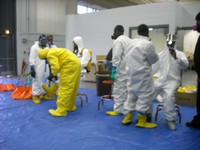 Workers clean up the environment: brownfields remediation, lead/asbestos/mold work, and more.
Detroiters Working for Environmental Justice (DWEJ)’s Green Jobs Training Program was recently awarded $96,000 in Recovery Act money. These funds increase the capacity of DWEJ's job training for environmental cleanup (brownfields remediation, lead/asbestos/mold work, and more) and “greenup” (energy audits, weatherization, deconstruction, etc.), targeting unemployed and underemployed Detroit residents. This program includes Detroiters who are most in need of an opportunity to enter the workforce: those returning from jail and people without GEDs. DWEJ has had 100% job placement, and at the end of the year, they will have placed 67 graduates. Next year they plan to graduate and place 75 participants. They had 500 applicants for the first training, and over 600 applicants for the second class. The funding provided by the Recovery Act is helping the program expand, filling a great need in Detroit for technical training for disadvantaged residents.
Recovery Act Investment: $96,000
Website: Click here to learn more.
MINNESOTA
A Time To Make Change
By Winona LaDuke, Executive Director, Honor the Earth
White Earth Reservation, Minnesota
 I have spent thirty years fighting dirty coal strip mines, uranium mines, mega dam projects, and most recently, the tar sands project in Canada. There are some terrible ideas about what the future is supposed to look like. We can already see it. I am also sure that there’s a better way.
In our Anishinaabe prophecies, this is viewed as a time to make this change, to take this opportunity. We are fortunate to live in a community with great natural wealth, and a people who remember who we are, who remember our traditions. We have good wood to heat our houses with and make new homes. We have wild rice to feed ourselves. We have good land on which to grow other food.
So our thinking is that instead of waiting for others to come to us with an idea of what it is we should do (like putting in a polluting industrial facility or selling products to a wasteful outside economy), we should restore the strength of the traditional economy and way of life of our people. We are also interested in how this relates to worldwide movements for food justice and energy justice. We believe that the basis of the durable economy is local, and responsible.
This past year I’ve been forced to make some of these decisions relating directly to my own life. This is to say that my family lost our house to a fire and we had some choices and opportunities. We decided to build a house using local and recycled materials, local labor and to include efficiency and renewable energy in the equation.
We found our logs on Craigslist- they were two years old, already cleaned, about a hundred miles away, and selectively cut from a family forest. We were able to secure most of our appliances, fixtures and windows from a deconstruction site (the ReUse Center at the Green Institute in Minneapolis, MN), and almost everything in the house is recycled. All of our labor was trained locally. We showed that it could be done, and I have helped inspire and encourage more tribal green building in our community and beyond.
MISSOURI
Kansas City's "Green Zone" Gets Major Lift in Helping Homeowners & Business Save Energy
Kansas City, Missouri
EnergyWorks KC was awarded $20 million in a federal grant to help Kansas City businesses and homeowners improve their energy efficiency. The program will help landowners select the appropriate improvements, pull together financing and ensure that the work is done correctly. Many improvements that increase energy efficiency are eligible for tax credits from the government and rebates from utilities, which will drastically decrease a property owner's out-of-pocket costs. According to the Kansas City Star, the EnergyWorks program will be a "one-stop shop" for property owners interested in making their homes and businesses more energy-efficient, thereby making energy efficiency accessible to hundreds of thousands of homes and businesses.
According to Representative Emanuel Cleaver, who represents the 5th district in Missouri, the grant will be "a sea change for urban Kansas City," as the program will focus on the "Green Zone" of Kansas City, a 150-block area that has been devastated over the years by high rates of poverty and unemployment and high concentrations of vacant and abandoned properties. The goal is to retrofit at least 2,500 buildings in the community, including residential, commercial and industrial structures. Kansas City was just one in 25 communities awarded the 2010 Better Buildings grant, which will continue to ramp up in 2011.
Watch Vice President Joe Biden award Kansas City $20 million:
Kansas City Uses Recovery Act Funds to Establish a "Green Impact Zone"
Kansas City, Missouri
U.S. Representative Emanuel Cleaver II has spearheaded an innovative new initative in Kansas City: a "Green Impact Zone". Leveraging $200 million from various Recovery Act funding streams and other local funds, Kansas City will transform a 150-block area in the urban core of the city into a model of green community revitalization. The project will train unemployed residents and ex-parolees for green jobs, weatherize the 2,500 homes in the Green Impact Zone, build a rapid transit bus route, and develop a smart grid energy project.
Recovery Act Funding Streams: Leveraging multiple investments (including the Weatherization Assistance Program) totaling $200 million
Website: Click here to learn more.
MONTANA
Rocky Boy's North Central Montana Water Project
Rocky Boy's Reservation, Montana
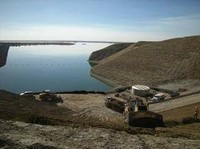
Rocky Boy's/Northcentral Montana Regional Water Project received $20 million in stimulus funds to build a treatment plant and install a pipeline that will deliver clean water to an area the size of Delaware. This investment has greatly benefited the Rocky Boy's Indian Reservation, with the tribally owned Chippewa Cree Construction Corp hiring more than 20 workers. Many others have also gotten jobs indirectly through this investment. Already the reservation is seeing vast improvements both in water quantity and sanitation, reducing the need to boil the water before use. "We can build it faster than Congress can deliver the dollars," Belcourt said.
Recovery Act Investment: $20 million
Websites: Click here and here to learn more.
Montana Energy Corps Members Delivering Solutions for Pocketbooks and the Environment
Montana
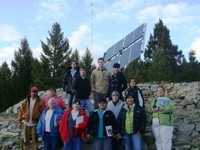 A new AmeriCorps project in Montana is placing members throughout the state to implement solutions for sustainable energy consumption. Energy Corps members provide hands-on energy assistance to underserved Montana communities. They perform energy audits, install energy conservation and weatherization measures, and help design, install and maintain a variety of sustainable energy systems. Members also provide energy awareness and education, encouraging individuals, families and small businesses to take proactive measures to address energy consumption to save on their energy bills and reduce their carbon footprints.
Website: Click here to learn more.
Warm Hearts Warm Homes
Helena, Montana
 Insulation cuts down energy costs.
In 2005 Warm Hearts Warm Homes Montana enabled Montana Conservation Corps (MCC) crews to help weatherize 600 low-income homes on Native American reservations. After seeing the impact, Governor Brian Schweitzer (who initiated the statewide program) increased funding in following years. Since the beginning of the program, Corps members have weatherized approximately 4,500 low-, middle-, and fixed-income homes statewide.
Website: Click here to learn more.
NEBRASKA
Nebraska Receives 10 Million to Ramp-Up Retrofits
 The City of Omaha and City of Lincoln, Nebraska Retrofit Ramp-up Programs received 10 million dollars under the Department of Energy's Better Buildings Initiative. The sustainable investment, which was made possible by the American Recovery and Reinvestment Act of 2009, was awarded in the spring of 2010 and will help Nebraskans save money on their energy bills, while also creating good, green jobs. Nebraska Retrofit Ramp-up Program will achieve a sustainable retrofit marketplace by focusing on the following strategic methods: workforce development, green technology and entrepreneurship, consumer information, financial mechanisms, neighborhood advocacy, and market strategy. The program aims to establish a long-term regional marketplace for retrofitting existing buildings, systematically delivering a critical mass of high-quality retrofit projects in an efficient, cost-effective, and environmentally sound manner, and building a scalable, sustainable model that can be replicated in communities throughout Nebraska and the Midwest. The Omaha-Lincoln Retrofit Ramp-up Program will provide home and building audits and retrofits to more than 80% of buildings–most of which were built prior to 1940–in designated "Green Zones" located in the cities of Omaha and Lincoln.
NEVADA
Nevada Making Diverse Investments in Energy Efficiency
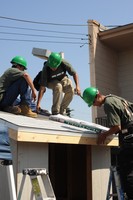 Nevada is covering a lot of ground with its Recovery Act investments. It is using Energy Efficiency and Conservation Block Grant Program funds to support local governments' energy-efficiency initiatives, install energy-management systems in state buildings, and equip emergency vehicles with emission-reducing idle-reduction technologies. The state will also replace inefficient traffic signals and street lighting and provide energy management training for government officials.
Recovery Act Funding Stream: Energy Efficiency and Conservation Block Grant Program ($9.6 million)
Website: Click here to learn more.
NEW JERSEY
GANE Advances High Labor Standards for Weatherization Work
Newark, New Jersey
The Garden State Alliance for a New Economy (GANE) has been coordinating with national staff at Change to Win and the Laborers Union to raise standards for weatherization work in the largely unorganized residential construction industry. In December 2008, the Laborers presented President-elect Obama with a proposal to dedicate ten billion dollars of weatherization funding to a competitive grant program that will be awarded to cities that set up weatherization programs which hire local residents, pay union-scale wages and benefits, and have strong local hiring requirements.
Website: Click here to learn more.
New Jersey Transforms Blighted Lots into Urban Eco-Village
Newark, New Jersey
 New Jersey weatherization workers.
The Newark Neighborhood Revitalization Project, managed by the Lincoln Park Coast Cultural District (LPCCD), is transforming a low-income neighborhood from blighted lots into an urban eco-village that includes 300 LEED-certified housing units, green-collar jobs, music festivals, historic restoration projects, and the Museum of African American Music. LPCCD recently completed six new LEED-certified buildings, called the Washington Street Mixed Use Buildings.
Additionally, LPCCD launched a new program in February 2008, The Green Collar Apprenticeship Program (GreenCAP). With a commitment to clean energy, sustainable development and well-paying jobs in mind, the program will aid the creation of a local, skilled green collar workforce. Local residents in the program installed solar panels on LPCCD's first housing project. Last spring, LPCCD launched a second green job program, the Green Job Training Program (GJTP) in partnership with the New Jersey Department of Labor and Workforce Development.
Website: Click here to learn more.
New Jersey Creates More Than 150 Green Jobs Fighting Pollution
New Jersey is continuing to establish itself as a leader among the states in green economic development. The state will use $14.4 million in Recovery Act funds to reduce fossil fuel emissions, decrease overall energy use, and improve energy efficiency at the state and local level — all while creating quality jobs. Energy Efficiency and Conservation Block Grant funds will provide state and municipal buildings with energy-efficiency upgrades, significantly reducing energy use and emissions while saving or creating more than 150 green jobs.
Recovery Act Funding Stream: Energy Efficiency and Conservation Block Grant Program ($14.4 million)
Website: Click here to learn more.
NEW YORK
Going Green for Buffalo's Youth
Buffalo, New York

Massachusetts Avenue Project's (MAP) Growing Green Program is a youth development urban agriculture program that has made a deep, positive impact upon the lives of thousands of youth in Buffalo, NY. Located on the city's west side, MAP nurtures the growth of a diverse and equitable community food system by promoting local economic opportunities, and by increasing access to affordable, healthy food in some of Buffalo's most impoverished communities.
MAP has intensively trained over 4,500 inner city youth, 375 of whom have been directly employed by the organization – increasing their knowledge of where food comes from, how to grow food organically, and how to cook healthy meals for themselves and their families. Growing Green youth also learn about the business of food as well as the impact the food system has on their own health and the health of their community.
The Growing Green Program is comprised of MAP's urban farm, an aquaponics system, a mobile market, and a youth enterprise.
- At The Growing Green Urban Farm youth learn to grow over 40 different varieties of fruits, vegetables and herbs, while learning valuable food-related green job skills.
- The aquaponics system, MAP's newest market-venture is modeled after a natural river system to raise organic Tilapia in a greenhouse. By 2011 it will house approximately 30,000 fish per year and will allow MAP to increase its organic fish and vegetable supply to local restaurants in the area.
- MAP's Mobile Market addresses food security by bringing fresh, healthy food from the Growing Green farm and other local organic farms to five low-income neighborhood sites on a weekly basis.
- Growing Green Works, MAP's youth-run enterprise, helps youth develop business and leadership skills through a hands-on educational training program in which youth collectively run a value added organic foods enterprise.
MAP attributes much of the success of its programs to a commitment of relationship building with youth and treating youth as leaders, the use of engaging and experiential teaching techniques incorporated in its job training, and its hands-on approach to skill building and empowerment. With such innovative programming and youth leadership development, it is no surprise that ninety-six percent of the youth who complete The Growing Green Program go on to attend college or vocational training.
In addition to the Growing Green Program, MAP is engaged in local and national policy work to implement systemic changes to our food system.
To learn more about MAP and its programs, visit www.mass-ave.org.
PUSH Buffalo Building National Model for Sustainable Community Development
Buffalo, New York
 For nearly 30 years, Buffalo's West Side — a low-income area with a high concentration of people of color — has suffered decreasing population, increased rates of housing vacancy, and small business decline. In the country's third-poorest city, it is one of the neighborhoods struggling the most. Now, community-based organizations are taking the lead in revitalizing Buffalo, and the West Side in particular.
People United for Sustainable Housing (PUSH) Buffalo is a grassroots, nonprofit community organization working to rebuild Buffalo’s West Side. PUSH and its allies have created a Green Development Zone on the West Side where they are reclaiming abandoned houses, retrofitting them to use less energy and produce renewable energy, and preparing them for occupancy by low-income residents. They are transforming vacant land by growing community gardens, planting tree farms, and constructing rain gardens. All of this will reverse environmental degradation, improve community health, and increase property values. Through strategic alliances — including with HomeFront, Inc., WNY Americorps, the Massachusetts Avenue Project, and Re-Tree WNY — PUSH Buffalo is leading the way in building a national model for urban transformation and revitalization.
Its efforts in the Green Development Zone will create a demand for trained and capable workers. With its innovative new pilot program Green Jobs for Buffalo, PUSH Buffalo is helping make sure thatBuffalo residents are prepared to meet that demand. Green Jobs for Buffalo will combine education, job training, and employment placement in green affordable housing rehabilitation and retrofitting, regional food system development, and environmental stewardship.
On July 13th, Green For All and PUSH Buffalo are hosting a convening about Green Jobs for Buffalo, and how the federal Community Reinvestment Act can support such innovative programs in creating jobs and career ladders in emerging sectors of the green economy.
PUSH is mobilizing residents to create strong neighborhoods with quality affordable housing, expand opportunities for local hiring, and advance economic justice in Buffalo. New York Governor David Paterson is a major proponent of the work PUSH and other Buffalo community organizations, saying earlier this year that "we need to return to promoting all that we have to offer, starting in Buffalo."
Green Worker: Marylue Matmungal
South Bronx, New York
 My name is Marylue Matmungal, and I reside in the one of the best cities in the world, New York City.
I have been working at my green job since December of last year and so far I love it. My company is called Rebuilders Source, and we are a reuse store for building materials that would have otherwise ended up in landfills. It’s been a wonderful experience, and I have learned a lot by being a part of the greening of the five boroughs of NYC. My job consists of marketing our company’s name to anyone who is looking for high quality building materials that are easy on the wallet and safe for the environment.
Along the way I form relationships with companies that want to be a part of the green movement. I can honestly say that standing for something as strong as reuse in today’s growing environmental challenges concerning sustainable waste stream management it really makes me feel great to be a part of the ongoing change. It’s extremely empowering to know that not only will my child see me affecting a change but will someday know that I stood up for something that helps us all as opposed to an individual company.
I think that when we set out to do our green jobs we expect to have great outcomes. Taking care of the planet is serious business and should be thought out with care and never rushed. Because anytime you create something new you have to break something else to do it.
Always remember REDUCE, REUSE, RECYCLE for a healthier planet
Weatherization in New York Creates Jobs, Opportunity
New York, New York
Tahlia Williams is a single mother of a 3-year-old son, in Brooklyn, NY. "Construction is something that I wanted to do for a long time," she said. "I had no way of knowing how to get into this field because I always heard it was a man's world."
Now, Tahlia has a job weatherizing homes in New York with the Community Environmental Center (CEC).
CEC is breaking ground on many fronts. It is the state's largest provider of the Weatherization Assistance Program (WAP), which weatherizes low-income homes. It is also the first WAP provider in the state to sign a contract with a union, the Laborers Local 10. As a union shop, CEC provides good wages and benefits to its employees while gaining access to the skilled workers it needs to respond to the expanded WAP investments in the Recovery Act. And a partnership with Non-Traditional Employment for Women is helping Local 10 recruit more women and historically disadvantaged workers for good, green jobs in weatherization.
Thanks to these partnerships and the Recovery Act's large investment in WAP, more low-income New Yorkers can benefit from services that lower their energy bills and make their homes more comfortable in the extreme temperatures of winter and summer. Taken together, these improvements to New York homes will make a real dent in the city's greenhouse gas emissions, 70% of which come from buildings. In November 2009, Good Magazine partnered with Green For All to tell the story of CEC in the short video below.
Recovery Act Investment: $16 million
Website: Click here to learn more.
Long Island Program Helps Homeowners Go Green
Long Island, New York
Long Island Green Homes Initiative is an innovative approach to financing that will make green retrofits readily available to homeowners — at little or no up-front cost, and without assuming new debt. By expanding the definition of "solid waste" to include wasted energy based on its carbon content, Babylon has freed up $2 million from its solid waste management fund to pay for the up-front costs of the improvements. Residents then pay the city back over time with a portion of the money they save on their energy bills.
Overall, residents see a modest decrease in their energy bills while the money is being paid back, and a more substantial one after that. Residents don't have to pay out of pocket for the improvements, and the obligation to repay runs with the property, so homeowners don't need to worry about whether they will live at the property long enough to recoup the cost of investment in the retrofit. With 65,000 homes in Babylon and average energy savings of 20-40% per retrofitted home, this creative, self-financing program will reduce the town's carbon footprint by 65,000-130,000 tons, reduce energy costs for homeowners, and create 6,600 new green-collar jobs.
Website: Click here to learn more.
Sustainable South Bronx Celebrates 100th Graduate of its BEST Academy
South Bronx, New York
Since its inception in 2001, Sustainable South Bronx (SSBx) has emerged as one of the nation's most innovative and successful environmental justice organizations. With a wide array of projects, including green-roof installation and community urban planning, SSBx seeks to foster environmental justice through economically sustainable, locally demanded methods. Foremost among these projects is the Bronx Environmental Stewardship Training Academy (BEST), which provides training and certification courses ranging from asbestos removal to urban forestry to New York residents. Most BEST student-workers are low-income, welfare-to-work, unemployed or underemployed. Since 2003, SSBx has trained 128 community residents to work in the burgeoning green-collar workforce.
Website: Click here to learn more.
Green Worker Cooperatives
South Bronx, New York
Green Worker Cooperatives is bringing community-owned green businesses to the South Bronx. The organization incubates worker-owned and environmentally friendly cooperatives to address high unemployment and decades of environmental racism in the South Bronx.
Website: Click here to learn more.
Green Jobs/Green New York Will "Green" One Million Homes and Create Thousands of Good Jobs
Albany, New York
The Green Jobs/Green NY program is a landmark statewide initiative to establish a revolving capital fund and make one million homes energy efficient in five years. This program will significantly lower greenhouse gas emissions, save families money on their energy bills, and create tens of thousands of green, living-wage jobs.
Website: Click here to learn more.
New York passes municipal clean-energy loan legislation
New York
The Senate and Assembly of New York passed landmark legislation empowering communities to launch Property Assessed Clean Energy (PACE) loan programs. PACE will enable municipalities to leverage federal funds to provide financing to commercial and residential property owners for energy-efficiency retrofits and renewable energy systems. Property owners can then opt into these programs and reap an immediate savings on their energy costs, repay the loans through an annual charge on their property tax bill.
Website: Click here to learn more.
OREGON
Portland Launches Groundbreaking Home-Retrofit Program and Community Workforce Agreement
Portland, Oregon
Using money from the federal Energy Efficiency and Conservation Block Grant Program (EECBG), Portland is launching a revolving loan fund that will help residents pay for energy-efficiency improvements to their homes. Residents have no up-front costs, and pay the loans back from the savings on their energy bills. This program will save energy, save money and create 10,000 local jobs. A groundbreaking Community Workforce Agreement will ensure that those jobs are available to workers from low-income and other disadvantaged communities.
Recovery Act Funding Stream: Energy Efficiency and Conservation Block Grant ($1.1 million)
Portland YouthBuilders Trains Young People for Jobs in the Green Energy Sector
Portland, Oregon
Portland YouthBuilders (PYB) provides educational, vocational, and leadership development programs for low-income men and women ages 17-24. Each year, PYB’s construction department serves an average of 100 people. Participating students receive training in the components of energy-efficient residential construction and build affordable housing for first-time homeowners. Bill Kowalczyk, PYB’s Construction Manager, describes the program as a "gateway to apprenticeship programs and family-wage jobs in the construction industry."
Recovery Act Funding Stream: U.S. Department of Labor Green Jobs Capacity Building Award ($100,000)
Website: Click here to learn more.
PENNSYLVANIA
ACTION-Housing creating business opportunities and jobs, streamlining energy efficiency process
Pittsburgh, Pennsylvania
 ACTION-Housing, the Weatherization Assistance Program (WAP) provider in Western Pennsylvania, has innovated to increase the impact of their energy efficiency work, at the same time as new ARRA funds have expanded their reach. ACTION-Housing has used the boost to grow from weatherizing 1,000 homes a year to being able to impact nearly 5,200 homes over the next three years. In the first three months of the expanded program an additional 1,600 homes were weatherized. They have already added 8 more approved women or minority owned contractors to their labor pool (a 27% increase), creating approximately 20 - 60 living wage, green collar jobs. The program has partnered with community organizations, foundations, labor, government and utilities through the Coordinated Weatherization Campaign. Innovations include coordinating with utilities who agree to share their list of high use clients and pay for some work, reaching residents through faith-based and neighborhood organizations, and building their contractor pool and workforce through training programs that target communities with high unemployment.
Recovery Act Funding Stream: Weatherization Assistance Program and $15.2 million in ARRA funds
Website: http://www.actionhousing.org
A Woman’s Work: Dawn Moody discusses her green-collar job in Philly
Philadelphia, Pennsylvania
 One of the most frequently asked questions is, "Where are the women in green jobs?"
With so much public attention focused in construction, a historically male-dominated field, people wonder about the role of women in green careers.
Meet Dawn Moody, longtime Philadelphia resident and green-collar worker with the Energy Coordinating Agency (ECA). The proud mother of a college freshman who encourages her peers to unplug appliances after use, Dawn is a living example of women who are redefining the industry in green construction.
“The best thing about my job is that I help people conserve energy and put a few extra dollars in their pocket. They don’t have to choose between buying groceries in the refrigerator or heating their house,” Dawn says proudly.
As a BPI Certified Energy Auditor, Dawn and her agency work with low to moderate-income residents to find ways to save energy in Philadelphia households. With so much of our carbon footprint stemming from wasteful energy use in our nation’s commercial and residential buildings, retrofitting homes and buildings goes a long way - in both environmental and economic savings.
And because housing in low-income areas is more likely to leak energy and heat, an energy audit can quickly identify low-cost solutions to better insulate the home and save substantial costs in high utility bills. As Dawn points out, those extra dollars can go a long way.
A Woman’s Work
With more opportunities for job training and employment in energy conservation than ever, ECA is spreading the word and working to bring more women into the field. They’ve joined up with the Veteran’s Administration, Women’s Health Resource Clinic in Philadelphia, PathWays PA, and other community organizations to increase access and awareness.
Dawn added that she understood the misconceptions about women in green jobs. “I think women underestimate themselves in believing they can’t do this work. But if you can become a mother, carry a child for 9 months, and get up at 3 o’clock in the morning to change a diaper, then doing an energy audit is a piece of cake.”
“Being green today,” Dawn said wisely, “means that 25-30 years from now, my grandchildren will be able to benefit from the energy conservation of my generation.”
Philadelphia Uses Recovery Act to Create Opportunities for Minority-, Woman- and Disabled-Owned Firms
Philadelphia, Pennsylvania
Philadelphia's plan for its $16 million in Weatherization Assistance Program funds includes an aggressive effort to create new opportunities for small minority-, woman- and disabled-owned firms (MWDBEs) in weatherization and energy-efficiency retrofits. City outreach efforts have already yielded remarkable MWDBE participation in the weatherization program, which grants these firms access to customized technical assistance services. Philadelphia aims to help these firms begin providing weatherization services in the private market, creating a new business opportunities for them while expanding access to energy-efficiency services.
Recovery Act Funding Stream: Weatherization Assistance Program ($16 million)
Website: Click here to learn more.
Philadelphia Hires 200 New Workers for Weatherization, Certifies Hundreds More.
Philadelphia, Pennsylvania
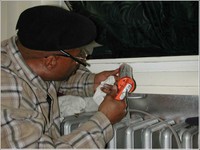 Caulking makes homes more energy-efficient.
Two hundred new hires will be trained at Philadelphia’s Energy Coordinating Agency (ECA) with funding from the American Recovery & Reinvestment Act. And an additional hundreds of experienced weatherization technicians will be certified by the State to weatherize the homes of low-income residents this year. Soon the state will also require Building Performance Institute (BPI) certification, which ECA will provide, a valuable asset to workers and a step up the career ladder in this field.
Website: Click here to learn more.
Philly Creating New Solar Installation School
Philadelphia, Pennsylvania
Philadelphia is using Workforce Investment Act funding from the Recovery Act to support a new solar installation school, run by the Maxwell Education Group. The first 25 students to attend the school started the program in September 2009 and will graduate in November 2009. The students learn basic math and job readiness skills along with basic electrical skills, solar system design, and panel installation and system wiring techniques. Students from this program are proving highly sought after, with several securing full-time employment in their new field weeks before their graduation, and many more moving into externships to provide on-the-job experience. All of the students in the program were unemployed when they began the training, and several were ex-offenders.
Recovery Act Investment: $150,000
Website: Click here to learn more.
Pittsburgh Coalition Comes Together to Create More Than 100 Green Jobs through Recovery Funds
Pittsburgh, Pennsylvania
A coalition in Pittsburgh is creating a targeted approach to strategically utilize Weatherization Assistance Program and other Recovery Act funds. The plan is to build workforce pipelines for weatherization workers and achieve economies of scale by focusing on five high-energy-use/low-income areas of Allegheny County. The coalition projects that Recovery funds will create 100-150 jobs and is working to leverage this opportunity to create jobs and business opportunities in the private sector. The coalition is made up of the City of Pittsburgh, Allegheny County, utilities, foundations, the local Workforce Investment Board, Community Action Agencies, and community-based organizations including GTECH.
Recovery Act Investment: $25 million
Website: Click here to learn more.
SOUTH DAKOTA
South Dakota Using Recovery Act Funds to Dramatically Reduce Energy Consumption
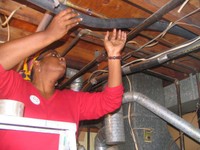 South Dakota is using funds from the federal Energy Efficiency and Conservation Block Grant Program (EECBG) to make the state dramatically more energy efficient, aiming to reduce overall energy consumption to 75% of 1990 levels by 2012. The state will invest the bulk of its EECBG funds in local governments based on factors like energy savings, job creation, long-term sustainability of the project, maximum benefit to the community, and local financial participation. All told, South Dakota will lower greenhouse gas emissions, reduce energy use, and save or create more than 100 full-time jobs.
Recovery Act Funding Stream: Energy Efficiency and Conservation Block Grant Program ($9.6 million)
Website: Click here to learn more.
TENNESSEE
Tennessee Plans to Weatherize More Than 10,5000 Homes in the Next Three Years
The Recovery Act is giving a huge boost to Tennessee's green economy. Using almost $40 million in Weatherization Assistance Program funds, Tennessee will weatherize more than 10,500 homes over the next three years. The state is prioritizing households occupied by the elderly, the disabled, and families with children under six years old, as well as those who have been on a weatherization waiting list for more than three years.
Recovery Act Funding Stream: Weatherization Assistance Program ($39.6 million)
Website: Click here to learn more.
TEXAS
Faith-Based Community Spearheads Innovative Energy Efficiency Initiatives
Houston, Texas

Pastor Walter August, Jr., and his 8,000-member church, Bethel Family Baptist Church, in Houston, TX, have served the Houston community for nearly 17 years. The church is known for its progressive ministries that provide after-school programs, vocational training, food, and financial assistance for the underserved. Most recently, Bethel Family has embarked on a path of environmental stewardship with its energy efficiency initiatives.
The church has set a goal of becoming the first ENERGY STAR labeled minority congregation church in the United States. They are engaged in a campaign to raise five million dollars to help build a 56,000 sq. ft. building that will allow the church to expand its social service programs. Their commitment to energy efficiency will not only help protect the environment, but will assist the church in saving thousand of dollars in energy bills in their current and future buildings. Both the new and existing facilities will undergo energy audits and will begin implementing the necessary steps to retrofit the buildings.
In addition to retrofitting its own facilities, the church is committed to becoming a valuable community resource for the emerging green economy. They provide training for green collar opportunities in the Houston market, which is the 15th largest market for green collar jobs in the United States. For existing contractors and engineers, trainings focus on how to update their skills for green collar jobs. For others, the trainings focus on how to tap into the green economy, or provide solutions on how to change the direction of an existing business model. Once members receive the necessary certifications for either themselves or their business, the church will work in tandem with its consultant Sustainable Training Services (STS) to provide job placement. For those not seeking certification, the church offers free workshops that provide practical energy efficiency solutions for everyday living.
Sustainable Training Services, LLC (STS) is dedicated to bringing minority contractors and individuals into the green economy. They coordinate the resourcing, training, outreach and associated support for the development of an evolving energy efficiency and renewable energy workforce, with a goal of economic independence and a pathway out of poverty for individual workers.
With Bethel Family’s innovative and comprehensive approach, the church is well on its way to becoming a leader in environmental stewardship within the faith-based community and throughout the entire Houston region.
For more information on STS, visit www.sustainabletrainingservices.com.
For more information on Bethel Family Baptist Church, visit www.bethelsfamily.org
In Austin, Recovery Act Puts At-Risk Youth to Work Building Green Homes
Austin, Texas
 Building a green home.
The Recovery Act is helping American Youth Works expand its award-winning, project-based education program Casa Verde Builders (CVB). By giving them the opportunity to build single-family, energy-efficient, affordable housing in East Austin, CVB provides at-risk young people with hands-on construction skills and applied academics. Recovery Act funds are also helping American Youth Works develop an entire Green Collar Workforce Training Center.
Recovery Act Funding Stream: Leveraging various Recovery Act funds for youth, service and conservation totaling $1.16 million
Website: Click here to learn more.
Houston Invests in Energy-Efficient Meters and Technology for Residents
Houston, Texas
Reliant Energy will get $19.9 million from the federal stimulus package to promote products that will use advanced meters to help customers monitor their power use and choose billing plans based on the times of day they use electricity. Services include a weekly e-mail update on electric usage, an in-home device to monitor electricity use and costs in real-time, ways to communicate with home appliances designed to work with the new technology, and retail power plans that charge less for electricity customers use during times of low demand.
Website: Click here to learn more.
Houston Helping Low-Income Residents Retrofit Their Homes for Free
Houston, Texas
Houston, in partnership with Centerpoint Energy, is taking steps to promote more sustainable and affordable growth. The City of Houston’s Residential Energy Efficiency Program (REEP) has retrofitted approximately 7,000 homes in Houston since 2006. This has created significant savings for homeowners while reducing energy-use pollution — all at no cost to residents. REEP's weatherization efforts are having a big impact. Weatherized homes are using 12-18% less energy than before. In summer, that number is as high as 20%. REEP has been incredibly effective at reaching residents an including them in the program. Recruiting neighborhood and faith leaders to reach out to residents, REEP has reached 50% participation levels in its target communities. And with no cost to the residents, REEP makes it very easy for them to participate.
Website: Click here to learn more.
UTAH
Utah Uses Recovery Act to Ramp Up Weatherization Efforts
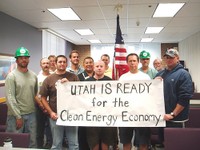 Salt Lake Community College students take a break from learning about solar PV design and installation.
Utah is taking full advantage of the Recovery Act's investment in the Weatherization Assistance Program, hiring 77 additional weatherization workers and contractors. This more than doubles the state's prior staffing levels, and is just the beginning of Utah's plans to ultimately create 120-150 new positions. Utah expects this new capacity to allow it to surpass the minimum 4,466 residential energy efficiency retrofits it must complete to satisfy federal requirements.
Recovery Act Funding Stream: Weatherization Assistance Program ($38 million)
Website: Click here to learn more.
VERMONT
Business and Professional Women's Foundation / Vermont Works for Women
 In 2009 Business and Professional Women’s Foundation launched Moving from Red to Green: Working Women in the Green Economy, an initiative to connect women with green jobs and increase their participation in the emerging green economy. With generous support from the Walmart Foundation, BPW Foundation has established 4 pilot programs across the country to expand the capacity to engage and train women for green jobs. One of the selected sites, Vermont Works for Women, helps women and girls explore, pursue and excel in nontraditional careers that pay a livable wage. Here is the story of Shalonda:
Shalonda was one of the first hires for the program, coming to FRESH Energy after three months on Vermont Works for Women’s Modular Home Building Program crew at Northwest State Correctional Facility. Prior to this, she had a combined employment history totaling 9 months and no experience in the construction field. Although she was entirely new to the Weatherization field, she clearly recognized the work as valuable to the community as well as to her architectural aspirations. Shalonda has flourished through her tenure on the crew. She has received very positive feedback from her on-site supervisor and she started her first college classes in January 2010.
Incarcerated Women Get Opportunity to Build Energy Star Homes
Winooski, Vermont
 The Vermont Works for Women has been helping women and girls since 1986 to enter and excel in nontraditional careers that pay a livable wage, despite the personal, educational or economic barriers that may stand in their way. Programs for both incarcerated and recently released women provide the opportunity to gain green carpentry training, learn valuable life-skills, and the chance to build affordable Energy Star modular homes.
Website: Click here to learn more.
WASHINGTON
Seattle Takes the High Road With Retrofit Program
Seattle, Washington


The city of Seattle took a major step forward in creating a strong and fair green economy locally with the adoption of the Community High Road Agreement for Residential Retrofit Projects. The Community High Road Agreement, which was unanimously adopted by City Council on July 26, 2010, will lead to the creation of thousands of high-quality, family-supporting jobs for qualified, historically underrepresented contractors and workers in the clean-energy economy.
Seattle is in the process of launching its $140 million "Community Power Works," which aims to achieve major energy savings and CO2 reductions while creating thousands of living-wage green jobs. Over the next three years, energy-efficiency audits and retrofits on more than 2,000 single-family homes will create upwards of 300 jobs. Now, the Community High-Road Agreement will ensure that those jobs go to the people who most need work right now.
The Community High-Road Agreement sets standards for broad access to economic opportunities for both businesses and workers, and for access to the quality training programs that set trainees on long-term, sustainable, career paths. It also creates mechanisms for stakeholders to play a central role in the ongoing implementation, evaluation and adjustment of Community Power Works. This both ensures that the initiative will benefit from the diverse expertise in the community and strengthens accountability and democracy.
By including high-road standards in its innovative residential retrofit program, Seattle is showing the rest of the country how smart green investments can grow local businesses and provide on-ramps to opportunity for low-income and historically underserved communities. Seattle’s example demonstrates that it is possible to create jobs, improve homes, save energy, and reduce carbon emissions — all at the same time.
Washington State: Bringing Energy Efficiency to Scale
Washington State
This year, Washington State paved the way to create hundreds of good, green-collar jobs with a new $58.5 million energy-efficiency program funded by President Obama's Recovery Act. Senate Bill 5649 uses money from the federal State Energy Program (SEP) to upgrade homes and businesses across the state to make them more energy efficient. Washington will also use SEP funds to spur the energy-efficiency and renewable-energy industries.
One of the most promising parts of SB 5649 is a $14.5 million effort to weatherize and retrofit moderate-income homes and businesses. This program will create new, quality green jobs, hire newly trained, local workers for those jobs, and retrofit 100,000 homes and businesses within five years. It will also create business opportunities for small contractors and reduce annual carbon emissions by 20,000 tons within two years.
Part of what has us so excited about this targeted effort is that it tackles energy-efficiency retrofits on a community-by community basis, not just a building-by building one. This will lead to economies of scale, making the program more effective and efficient. Another exciting element of Washington's program is the opportunity it provides to workers, homeowners and small businesses.
Green For All worked with community advocates and members of the legislature to ensure that the bill benefited community members and included job-quality standards. The Sound Alliance and Spokane Alliance led this successful effort, and Laborers’ International Union of North America, Puget Sound Sage, Senator Phil Rockefeller and Representative John McCoy were all key in making this groundbreaking legislation possible.
Contractors performing SB 5649 retrofits must pay their workers prevailing wages. Some contractors are going even farther in extending opportunity to Washington workers. Nonprofit SustainableWorks has pledged that 20% of its workers on SB 5649 jobs will be apprentices, and that 25% of those apprentices will be new, first-year apprentices. With the support of Electrical Workers, Plumbers and Pipefitters, Laborers, Sheet Metal Workers Unions and others, SustainableWorks will place individuals from under-served communities directly into apprenticeship programs that usually require a long waiting period.
Recovery Act Funding Stream: State Energy Program ($58.5 million)
Website: Click here to learn more.
Laborers Union Provides Weatherization Training to Seattle Area Residents
Kingston, Washington
The Laborers International Union of North America (LIUNA)’s Weatherization Training Program is partnering with Got Green to offer first-time training for 20 people. 10 are members of LIUNA and 10 are young men with disadvantaged backgrounds. On Nov. 5, 2009 the first class graduates from a two-week program that offers credentials in entry-level, weatherization technician/installer core competencies.
Seattle Prepares Workers for Lifelong Skills and Provides Pathways Out of Poverty
Seattle, Washington
Located at the intersection of Seattle’s most diverse neighborhoods, Seattle Vocational Institute Pre-Apprenticeship Construction Training (SVI PACT) is an effective pre-apprenticeship training program focusing on low-income minorities and women. An often overlooked step in the training process, pre-apprenticeship training addresses the skills gaps that prevent acceptance into construction trade apprenticeships. The PACT model has been extremely successful: 90% of students graduate, 90% of graduates enter trade apprenticeships, and the retention rate for PACT-trained apprentices is 10% higher than the national average.
Website: Click here to learn more.
WISCONSIN
Green Worker: Trang Donovan
Electrical Contractor / Renewable Energy Installer / PV Instructor, Midwest Renewable Energy Association
 As a mainstream electrician, I took the very first PV courses offered by the IBEW because I thought the technology was interesting. It wasn’t until I had spent some time on a small remote island off the East Coast of Nicaragua that I got the inspiration to pursue renewable energy as a calling.
On the island resources were limited, replenishing supplies was challenging. I had several epiphanies. One, this precious island was a microcosm of our planet. Two, renewable energy is not only viable, but also crucial for sustainable living. Three, I was really slow not to have gotten this all sooner. I also realized that I was ill equipped and lacked the experience to face the challenge of working on so many of the funky and defunct off-grid energy systems I encountered on the island.
When I came back home to the States, I aggressively pursued more renewable energy training through places like the MREA and SEI to set myself in the right direction. The MREA was instrumental in honing my skills and field experience as an installer to transform me into a more confident and effective instructor. They gave me the opportunity to make a contribution, gave me guidance, and continue to support my growth.
[My advice for women interested in the entering the renewable energy field…] Better get started now, you clever gals! There’s a lot to be done…
Article excerpted from interview posted on RE News-Newsletter of the Midwest Renewable Energy Association
WEST VIRGINIA
The JOBS Project Energizes Central Appalachia
West Virginia, Kentucky, and Ohio
 Philosopher, artist, tech-/econ-geek, and community organizer, Green For All Fellow Eric Mathis of the JOBS Project is striving to develop innovative approaches to sustainable development in the heart of the coalfields. He works with a small staff of two, along with the ongoing support of community stakeholders and many collaborative partners, including Mid-Atlantic Technology, Research and Innovation Center, Mountain View Solar, Alpha Energy, Center for Economic Options, Bridgemont CTC, WV HUB, and many more. Mr. Mathis is helping to bring renewable energy projects – and more importantly, sustainable development – to those areas that will be most affected during our shift to a green economy.
Earl Long, a former coal miner and The JOBS Project's community wind organizer, has successfully organized key landowners who are now active members of Angel Winds Renewable Energy, LLC in Monroe County, West Virginia. Angel Winds could become the first utility scale locally-owned wind farm in the Central Appalachian region with an upward capacity of 16 Megawatts from large commercial scale wind turbines. The project will potentially produce enough energy to power over 6,000 West Virginia Homes. With the help of Jenny Hudson, The JOBS Project's workforce development coordinator,  they have developed an innovative approach to workforce development by creating a wind training program at Monroe County Technical Center in order to provide jobs in a community that has little to offer students after graduation. The participatory nature of this project also emphasizes local wealth generation by facilitating the creation of a local energy efficiency and renewable energy fund, which will pool local capital for investment in this project as well as others like it. Additionally, Mr. Mathis is laying the institutional framework for an employee-owned model in which the operation and management (O&M) of workers are actively participating in the innovative processes for technological change by interlocking their suggested tweaks to processes with the work of local research and development firms. This model is similar to Toyota's world renowned approach to technological innovation which provides "shop floor" employees the opportunity to suggest changes to various processes.
Meanwhile, in the heart of the coalfields, The JOBS Project is presently developing a "jobs creation" approach to installing solar thermal and photovoltaic systems on the roofs of local businesses and residential homes as well as creating a replicable model for sustainable development entitled simply "Sustainable Williamson."  Taken together, along with an emphasis on energy efficiency, The JOBS Project is spearheading a viable model for transitioning to more healthy, sustainable, and economically diverse communities, aiding the coalfield region in preparing for the new green economy. This project was recently featured on BBC and NPR. Additionally, Mr. Mathis, along with Mike McKechnie of Mountain View Solar, recently received Interstate Renewable Energy Council's Innovation Award for Community Renewables for the solar project located in Williamson, West Virginia.
While projects in urban environments have have received much focus in the past few years by Green For All, The JOBS Projects hopes to bring a rural twist to its approach. In collaboration with Green For All, Mr. Mathis and several Green For All Fellows are working to develop the Rural to Urban Initiative, which highlights the importance of rural communities in sustaining the urban environment. To begin, this project will specifically focus on fossil fuel based communities, much like Williamson, in hopes of creating a network of rural communities and organizations who will share "best practices" as well as provide general support for building an inclusive green economy with emphasis on sustainable or "smart" development. Moreover, these rural networks will continuously build linkages with their surrounding urban neighbors such as Albuquerque, New Mexico, connecting them to their rural neighbors in order to build rich and productive networks that facilitates the creation of a new, "smart" green economy.
WYOMING
Wyoming to Get More Energy Efficient
Cheyenne, Wyoming
 Wyoming will use $9.5 million in Recovery Act funds to make a wide range of facilities more energy efficient, including facilities owned by local governments, tribal entities, non-profit organizations and joint powers boards. These funds, from the Energy Efficiency and Conservation Block Grant Program, will pay for insulation, air sealing, attic and ceiling improvements, upgraded lighting, insulation and sealing of HVAC (Heating, Ventilation and Air Conditioning) ductwork, the replacement of boilers/furnaces, and the installation of on-demand water heaters, among other measures. These investments will create jobs, cut energy costs, and reduce the harmful emissions that lead to pollution and climate change.
Recovery Act Funding Stream: Energy Efficiency and Conservation Block Grant Program ($9.5 million)
Website: Click here to learn more.
Northern Arapaho Tribe Poised to Lower Energy Costs for Indigenous Community
Wind River, Wyoming
The Recovery Act's investment in the Weatherization Assistance Program will allow the Northern Arapaho Tribe to weatherize about 125 homes over the next three years on the Wind River Indian Reservation in Wyoming. The program will prioritize homes that most need these improvements - homes with emergency or life-threatening conditions, homes of the elderly or disabled, homes of families with young children under six, and households with high energy burdens. If it successfully implements its plan, the tribe will receive almost $480,000 in additional funding for a total of more than $950,000.
Recovery Act Funding Stream: Weatherization Assistance Program ($382,484)
Website: Click here to learn more.
